
How Caeser works
Caeser is a Go-first CI failure triage tool. Its default GitHub integration reads evidence from an existing failed run, inspects the failing revision, and publishes source leads. It can collect more evidence through explicit test execution. Optional model analysis consumes the deterministic report afterward.
Components and deployment
Section titled “Components and deployment”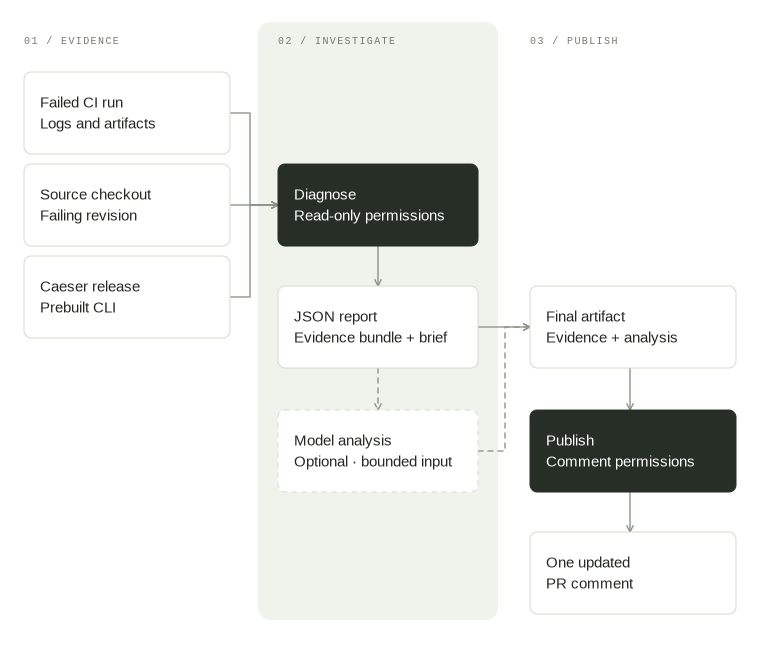
The three jobs - diagnose, analyze and publish - are defined in
ci-diagnose.yml. They run in the caller’s
GitHub Actions account. There is no Caeser-hosted service, no Blacksmith
requirement, and no model subscription required for the default path.
| Component | Responsibility | Location |
|---|---|---|
| CLI | Configuration, evidence ingestion, diagnosis, brief export, analyze and repair commands |
cmd/caeser/ |
| Evidence parsers | Logs, test reports, compiler/race evidence, coverage artifacts | internal/diagnosis/ |
| Repository analysis | Source symbols, typed Go calls, bounded SSA graphs | internal/repository/ |
| Source localization | Frame-to-symbol mapping, candidate ranking, likely_function shortlist |
internal/localization/ |
| Diagnosis pipeline | Staged diagnosis orchestration from evidence to report | internal/diagnosis/pipeline.go |
| Durable investigation engine | Investigator, hypotheses, experiments, patches and verification behind repair, debug and MCP |
internal/engine/, internal/investigation/, internal/reasoning/ |
| Source relationships | Typed call and dependency discovery | internal/relationships/ |
| Runtime probes | Candidate selection, instrumentation, execution and correlation | internal/diagnosis/runtime_*.go |
| Execution | Local commands and Docker execution policies | internal/execution/ |
| Optional model harness | Bounded evidence input, source retrieval and output validation | internal/agent/ |
| State and history | SQLite records and historical incident lookup | internal/persistence/, internal/history/ |
| Gateway | OpenAI-compatible HTTP adapter for configured model providers | cmd/gateway/, internal/gateway/ |
| MCP server | Local stdio tools for agent clients | cmd/mcp-server/, internal/mcp/ |
| GitHub integration | Evidence download, artifact transfer, comment update | .github/workflows/ci-diagnose.yml |
| Setup action | Download and verify a released CLI; add it to PATH | action.yml |
1. Identify the execution
Section titled “1. Identify the execution”The caller supplies the failed run ID and head commit. Caeser checks out that revision and downloads the failed jobs’ logs and available artifacts. A base commit can be recorded too. Knowing the base commit alone does not establish that the PR introduced the failure.
Evidence keeps source/run identifiers and digests where available. A stack location is meaningful only against its matching source revision. Rebuilt binaries cannot be used to resolve offsets from the original CI binary.
2. Normalize observed failures
Section titled “2. Normalize observed failures”The parsers turn Go test output, assertions, panic stacks, compiler diagnostics, race reports and structured test artifacts into failure episodes and evidence items. Raw bounded evidence remains available for inspection. Coverage profiles can supply executed source ranges when uploaded by the original CI run.
The reusable workflow does not currently generate coverage automatically. Missing coverage is reported as missing evidence, not treated as proof that a function was unexecuted.
With usable failure evidence and artifact-first mode, the original run supplies
the observed failure. Local reproduction is marked deferred. With no usable
failure evidence, diagnose can enter the configured reproduction path; see
CI integration before enabling command execution.
3. Find source leads
Section titled “3. Find source leads”Caeser maps observed file/line locations to source symbols, uses typed Go call relationships where available, and ranks implementation candidates. The report distinguishes observed stack frames from inferred callers and other source leads. The bounded candidate report contains up to five entries; the short PR comment displays fewer leads to stay readable.
On top of the candidate report, the likely_function shortlist names one
primary suspect and up to three alternates, each with a file, function, line
when available, reason, provenance kind, confidence and evidence IDs. It ranks
observed stack locations and exact SSA dependency values from the failing
assertion above generic inferred calls, and remains available when probing is
off, unavailable or inconclusive. It is not produced from file-level
localization alone. The shortlist is a developer/assistant handoff aid; a lead
is not a verified mechanism or PR attribution.
For Go, parsing uses the standard library AST. Typed calls and SSA use
golang.org/x/tools. SSA describes possible value dependencies and can trace
backward from a failing assertion. Localized implementation functions also
supply SSA candidate operations when the assertion trace is incomplete.
Analysis is bounded. Missing dependencies, unresolved interface calls, package budgets and unsupported expressions can leave a graph incomplete. Finding a file or reaching a constructor does not establish the failing operation.
4. Collect additional evidence when requested
Section titled “4. Collect additional evidence when requested”These are separate capabilities; they are not all enabled by installing Caeser.
| Path | Trigger | What it establishes |
|---|---|---|
| Existing CI evidence | Failed log/report supplied | A failure was observed in that execution |
| Reproduction | Explicit command execution, or normal diagnosis without usable original failure evidence | Outcome of the configured command in the new environment |
| Base comparison | Base supplied and execution permitted | Whether the targeted command fails on each revision |
| Go cold path | --go-cold-path, Docker required |
Focused test execution with a retained binary and provenance |
| Runtime operation probes | --runtime-observation |
Values observed at selected source operations; stronger proof requires correlation |
| Repair | Explicit repair command/options | Proposed patch and separately recorded verification outcome |
Probe selection mixes SSA operations with source candidates anchored by stack frames or existing coverage. It tries a bounded set of candidates, instruments supported expressions, preserves evaluation order, and retains the executed binary digest. Unsupported rewrites abstain. A source-only operation cannot satisfy the SSA verification requirement by itself.
In the v9 line, an empty operation shortlist can fall back to exact localized
implementation declarations. This last-resort path tests single-expression
returns, rotates between up to five functions within the existing five-operation
budget, and records selection_reason: localized_function_hypothesis. It does
not assume the function ran in the original CI execution. Ambiguous declarations,
file-only leads, tests, stale ranges and paths outside the workspace are rejected.
Failure preservation also recognizes sequential native Go test output, including GitHub job-log prefixes. It requires the same failing test set, one matching file/line check and an unambiguous expected/actual signature across repeats. Parallel native streams and repeated or conflicting check blocks abstain. Invocation correlation and mechanism verification remain separate requirements.
Testify matching also checks the exact numeric file/line and a single named
assertion block. Identical copies of a complete CI log retained in different
report fields are deduplicated for probe matching; repeated checks inside one
log remain ambiguous. Signature labels are not inferred from identifiers such
as actual_test.go or from empty expected/actual fields.
The runtime loop records candidate selection, build, execution, failure preservation and invocation-correlation outcomes separately. A logged value is a useful observation, but matching a number without binding it to the failing invocation is not a verified mechanism. The strict promotion path also requires matching revision, cited evidence, exact dataflow support and a supported mechanism check. Arbitrary Go bugs are outside the current verifier’s coverage.
Repair is a separate opt-in path driven by internal/engine: caeser repair
generates and verifies patches, and caeser debug runs the durable
investigation flow used in evaluation. Neither runs in the default PR workflow.
5. Render what the evidence supports
Section titled “5. Render what the evidence supports”The engine records classification, reproduction status, observed incidents, candidates, uncertainty and next checks. The candidate tier is presentation-only; it does not promote a root-cause claim. Some reports identify only the test or leave the mechanism unresolved. Those outcomes are included in evaluation.
caeser-report.json is the structured record. caeser brief turns it into a
readable Markdown brief without invoking a model or rerunning the program.
The publication job renders a short comment with expandable detail and updates
its existing comment. See reports.
6. Optional model investigation
Section titled “6. Optional model investigation”When agent: true, a separate job passes a bounded evidence package to the
configured model gateway. With agent_code_retrieval: true, the model may
request bounded Go source snippets/search results from Git objects at the
reported revision. This is source retrieval, not a vector database or an
unrestricted shell agent.
The harness constrains requests, sizes and evidence references. Model output is labeled separately and cannot change deterministic classification or mechanism verification. Valid evidence IDs do not guarantee that the model’s explanation is correct. A model failure leaves the original report available.
Runtime and security boundaries
Section titled “Runtime and security boundaries”Caeser’s orchestration and the Docker isolation boundary are documented separately in Execution and sandbox orchestration. That guide covers workspace creation, policy validation, command lifecycle, output and artifact capture, cancellation and cleanup, with links to the code.
- v9.1 downloads a checksum-verified Linux amd64 binary. Caeser is built once per
release. Setting
caeser_version: mainexplicitly selects a development build. - Target toolchain setup, dependency resolution and test compilation are separate costs. Prebuilding Caeser does not prebuild arbitrary target repositories.
- Local execution runs with the runner’s privileges. It is not a container.
- The Docker executor uses a disposable container, disables networking, drops capabilities, applies resource limits and mounts an isolated workspace. The image/dependencies must be prepared before a network-disabled test run.
- Diagnosis has read permissions and does not persist checkout credentials. Optional analysis receives only its configured gateway secrets. Publication consumes report artifacts and has comment permissions.
- The starter caller excludes fork PRs. Do not remove that guard without reviewing the execution and publication boundary for your deployment.
- Logs and briefs can contain private source or sensitive output. Review before sharing. Caeser does not send telemetry by default; enabling an external model sends the selected evidence to the configured provider.
What the alpha has demonstrated
Section titled “What the alpha has demonstrated”The small reviewed development set localized the culprit file in 10 of 14 cases, compared with 7 of 14 using stack-file extraction. List sizes differed. The frozen 16-case probe rerun preserved one probe and verified zero mechanisms. These are separate measurements, not a general root-cause success rate. See evaluation and external validation for the artifacts and limits.
Persistence
Section titled “Persistence”Caeser can persist investigations, lifecycle events, evidence, hypotheses, experiments, patches, and verification reports in SQLite. The store is used by the gateway and MCP server when they need durable investigation state.
Persistence does not make a diagnosis correct. It records what was observed so that the result can be inspected and recovered.
Repository artifact caching and incident memory are separate. The artifact cache keys overviews and snapshots by repository identity, commit, analyzer version and artifact identity. Historical retrieval queries the retained store for related failures and symbols in the same repository, preserving prior revisions and uncertainty. It does not turn a previous diagnosis into a current fact. Fresh hosted runner jobs need explicit store/cache persistence to reuse that context across runs.
Gateway
Section titled “Gateway”The gateway is a small OpenAI-compatible HTTP adapter. It keeps provider-specific
wire formats outside the diagnosis engine. The supported providers are a fixed
set: ollama, openai, openai-compatible, gemini and byok. Requests with
any other configured provider return an unsupported provider error.
Start it locally with:
CAESER_GATEWAY_PROVIDER=ollama \CAESER_GATEWAY_MODEL=qwen2.5:7b \go run ./cmd/gatewayEndpoints:
GET /healthGET /v1/modelsPOST /v1/chat/completionsGET /v1/investigations/<id>/events
The gateway currently handles non-streaming model completions. Request and output limits are enforced by the gateway and provider clients.
Server-Sent Events
Section titled “Server-Sent Events”GET /v1/investigations/<id>/events streams persisted investigation lifecycle
events as Server-Sent Events.
The stream:
- sends the existing events after the supplied cursor;
- accepts
Last-Event-IDfor reconnecting; - polls for newly persisted events;
- sends keepalive comments every 15 seconds;
- closes when the client context ends.
The cmd/gateway command opens the SQLite store on startup from CAESER_DB
(default ~/.caeser/investigations.db) and exits if it cannot be opened. In the
library, a gateway built without a store still serves model requests, but its
SSE endpoint returns HTTP 503 with SSE store not configured.
Example:
curl -N \ -H 'Accept: text/event-stream' \ http://127.0.0.1:8787/v1/investigations/INVESTIGATION_ID/eventsMCP server
Section titled “MCP server”The MCP server is a separate local integration for agent clients. It uses stdio JSON-RPC and requires an explicitly authorized repository root.
go build -o caeser-mcp ./cmd/mcp-server./caeser-mcp --root "$PWD" --db "$PWD/.caeser/mcp.db"The server exposes 16 tools covering investigation lifecycle
(start_investigation, cancel_investigation, get_investigation,
list_investigations), evidence and hypotheses, experiments
(approve_experiment, run_experiment, cancel_experiment), patches
(list_patches, get_patch, verify_patch), and verification and final
investigation reports.
Some tools execute commands or generate and verify patches rather than only reading state. The same repository-root, command, size, timeout and environment restrictions apply to all of them. The server is for explicitly authorized local use and is not the GitHub Actions integration.